What is the Real Cost of Closed-Cell Spray Foam Insulation in Kalispell Homes
Closed-cell spray foam insulation in Kalispell homes costs between $1.00 and $1.25 per square foot per inch of thickness installed,…



Open-cell spray foam insulation reduces outside noise through its unique cellular structure, which absorbs sound waves rather than merely blocking them. The material’s open-cell matrix creates countless tiny air pockets that trap sound energy, converting it into heat through friction as sound waves travel through the foam. This absorption capability makes open-cell spray foam particularly effective at reducing airborne noise like traffic, neighbors, and urban disturbances, with sound transmission class (STC) ratings typically improving by 50% or more when properly installed.
The following guide explains exactly how this insulation technology works to create quieter indoor environments, compares it to other options, and provides practical insights for homeowners considering this solution for noise reduction in busy areas.
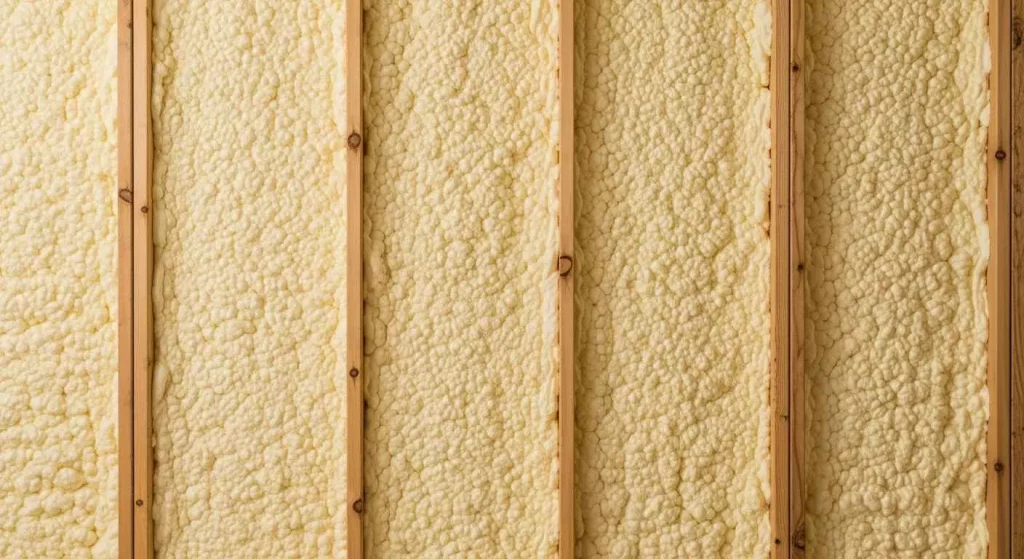
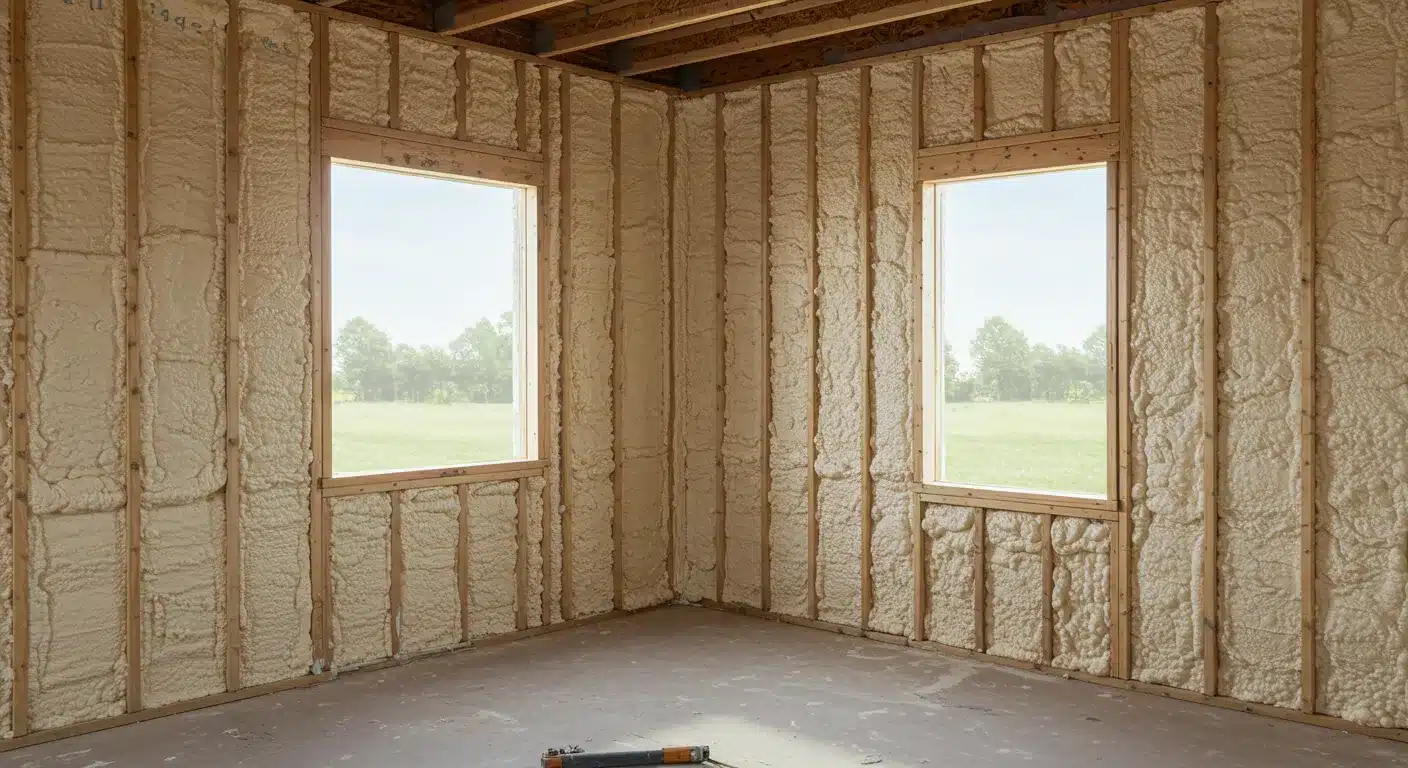
Open-cell spray foam creates a continuous air barrier that fills every cavity, gap, and crack in your walls, ceilings, and floors. Unlike traditional insulation that leaves spaces and seams, this material expands up to 100 times its original volume, sealing all potential sound pathways. The foam’s open-cell structure means the cells are not completely closed, allowing sound waves to enter and get trapped within the material’s matrix.
Sound reduction occurs through two primary mechanisms. First, the foam’s cellular structure causes sound waves to reflect repeatedly off cell walls, dissipating energy with each reflection. Second, as sound waves travel through the foam, their motion generates friction between the air and cell walls, converting sound energy into small amounts of heat. This dual action makes open-cell spray foam significantly more effective than other insulation types at mid- to high-frequency sounds, including most neighborhood noise.
Different insulation materials vary dramatically in their sound reduction capabilities. Open-cell spray foam outperforms most alternatives due to its air-sealing properties and cellular structure, but understanding the differences helps homeowners make informed decisions.
| Insulation Type | STC Rating Improvement | Sound Absorption | Air Sealing | Density (lbs/ft³) |
|---|---|---|---|---|
| Open-Cell Spray Foam | 50-70% | Excellent | Complete | 0.5 |
| Closed-Cell Spray Foam | 45-60% | Good | Complete | 1.5-2.0 |
| Fiberglass Batts | 25-40% | Fair | Poor | 0.5 |
| Mineral Wool | 35-50% | Good | Poor | 1.5 |
| Cellulose | 30-45% | Good | Moderate | 1.5 |
Research from the Building Science Corporation confirms that air leakage accounts for up to 50% of a wall’s sound transmission problems. Since open-cell spray foam provides a complete air seal, it addresses this major weakness in other insulation systems that rely on separate air barriers.
Proper installation directly affects how much noise reduction you’ll achieve. The foam must reach its full expansion potential and create a continuous barrier without gaps. Professional installers spray the material in thin layers, allowing each layer to expand before applying the next one. This technique prevents voids and ensures consistent density throughout the insulated area.
Wall assembly design also matters. For maximum sound reduction, consider staggered stud construction or adding a resilient channel before drywall installation. These techniques break the direct sound path through structural elements. In busy urban environments, homeowners often see the best results when applying spray foam in combination with other sound-dampening materials like double drywall layers with special acoustic compound between them.
Bonus tip: In walls where electrical outlets and plumbing penetrate the insulation, apply additional foam sealant around these penetrations after installation. These small openings can significantly compromise the overall sound barrier if left unsealed.
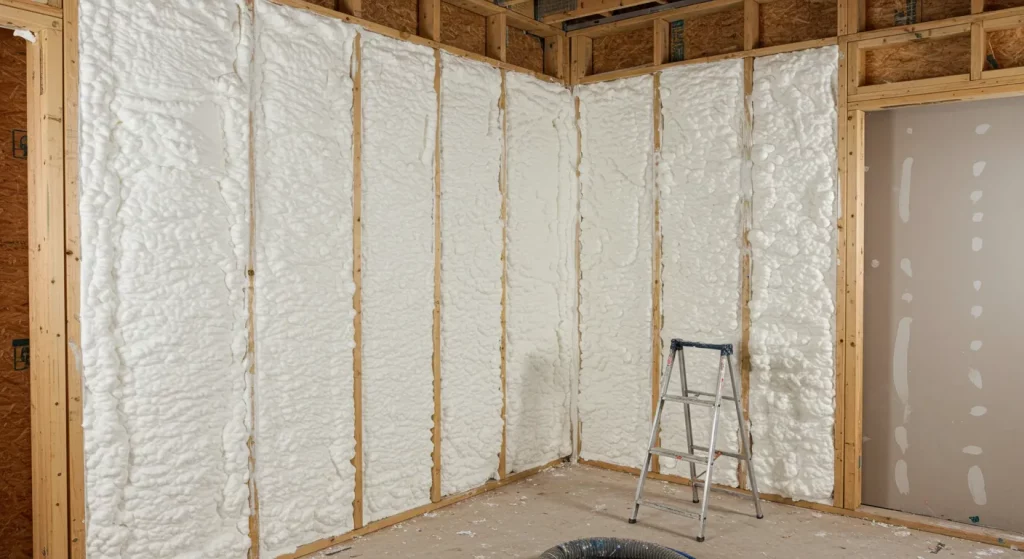
Open-cell spray foam requires specific installation conditions and carries some important considerations. The material needs professional application with specialized equipment, making it more expensive upfront than DIY options. However, the long-term energy savings often offset initial costs within 5-7 years according to the U.S. Department of Energy.
Climate affects performance significantly. Open-cell foam’s open structure allows moisture vapor to pass through, making it suitable for mixed climates but problematic in very humid regions where moisture infiltration could occur. In areas with extreme humidity variations, closed-cell foam might be a better choice despite slightly lower sound absorption qualities.
Recent market data indicate that open-cell spray foam installation rates vary nationally, with urban locations typically commanding higher fees. However, this investment enhances property equity, as HomeLight’s 2022 analysis confirms that homes equipped with spray foam insulation generally sell for a premium compared to the market average HomeLight Market Analysis.
Bonus tip: Request a test area installation to evaluate the noise reduction benefits before committing to fa ull-scale application. This approach lets you verify the sound-dampening effects in your specific environment.
The type of neighborhood noise you’re trying to block influences insulation performance requirements. Urban areas with constant traffic and city sounds typically have different frequency profiles than suburban neighborhoods with intermittent noise. Open-cell spray foam performs particularly well against mid-range frequencies (500-2000 Hz), which include most human speech and traffic noise.
In dense metropolitan areas, combine spray foam with window upgrades for optimal results. Even the best wall insulation won’t help if sound comes through poor-quality windows. Double or triple-pane windows with laminated glass provide the most effective complementary sound barrier.
Open-cell spray foam insulation provides significant noise reduction for homes in busy neighborhoods through its superior sound absorption and air sealing. When properly installed, it can reduce outdoor noise transmission by half or more, creating dramatically quieter indoor environments. The technology works best as part of a comprehensive sound-control strategy that addresses windows, doors, and structural design elements.
Before making your decision, evaluate your specific noise challenges, climate conditions, and budget constraints. Consider starting with a test installation to verify performance in your environment, and always work with certified installers who understand both the technical requirements and local building codes for your area.
Determining the right insulation solution for noise reduction requires a professional assessment of your specific situation. For homeowners in busy neighborhoods considering open-cell spray foam installation, Wegner Insulation provides comprehensive evaluations to identify noise pathways and recommend targeted solutions. Contact the team at [email protected] or call (406) 654-4636 to schedule an assessment of your home’s sound insulation needs and receive a detailed quote for spray foam installation.
Open-cell spray foam provides both thermal insulation and sound reduction, while dedicated acoustic products focus solely on sound control. For most residential applications, spray foam offers sufficient performance with the added benefit of energy efficiency.
Once cured, spray foam is completely inert and safe for all household members. The installation process requires temporary evacuation due to fumes, but properly cured foam poses no health risks.
Retrofit applications require removing drywall or accessing wall cavities from the exterior. While possible, it’s more expensive and disruptive than new construction applications.
The foam cures within 24-48 hours, providing immediate sound reduction benefits. Full acoustic performance is achieved once the material has fully cured, typically within 72 hours.
Yes, by filling wall cavities around pipes and ductwork, spray foam reduces transmission of mechanical noise. However, dedicated acoustic wrapping around very noisy HVAC units may still be necessary.